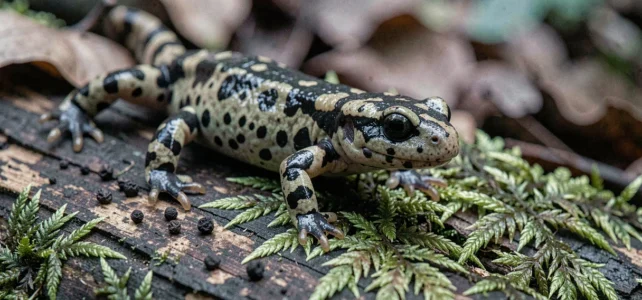
Amphibian droppings are among the most underutilized biological samples in ecology. In salamanders, these few millimeter droppings contain a wealth of information about the animal’s diet, health status, and ecological interactions. The recent development of molecular techniques applied to feces is changing the game for researchers working on forest biodiversity.
Fecal metabarcoding: the technique that transforms a poop into a database
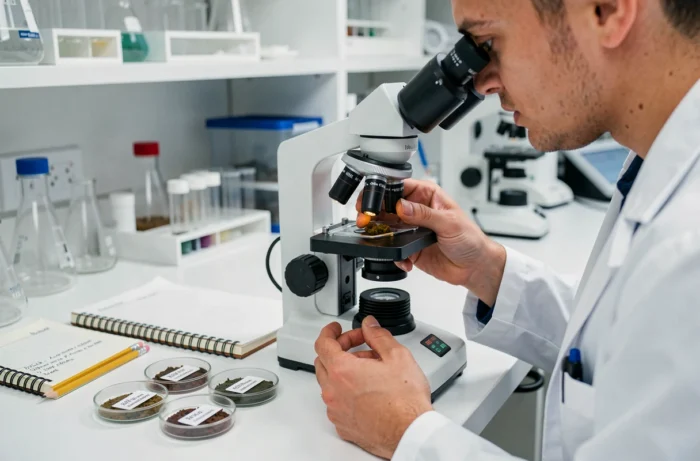
Environmental DNA metabarcoding is the process that gives salamander droppings their scientific value. The principle is based on the extraction of DNA fragments present in the feces, followed by amplification and sequencing to identify the ingested organisms.
In practical terms, a single dropping can contain the DNA of dozens of species of insects, arachnids, or worms consumed by the salamander. High-throughput sequencing compares these fragments to reference genetic databases and produces a detailed list of prey. This allows for an inventory of the local invertebrate fauna without setting a single trap.
This approach, well-documented in birds and mammals, is technically transposable to small terrestrial vertebrates. Salamander droppings, easy to collect in the field and rich in ingested DNA, are an excellent material. There is indeed much to learn about salamander droppings to discover, particularly their ability to reconstruct an entire food web from a tiny sample.
Standardization of fecal analyses: a reproducible pipeline for research
Collecting droppings is not enough. It is also necessary for the results obtained in one laboratory to be comparable to those of another. This has been the problem with metabarcoding since its inception: each team used its own protocols, making studies difficult to compare.
In 2026, a complete analysis pipeline called MAP (Metabarcoding Analysis Pipeline) was proposed to address this gap. This workflow covers the entire process, from raw sequence to final taxonomic identification. It manages highly multiplexed designs, with many individuals sampled from different sites and at different dates.
MAP makes studies on fecal DNA reproducible and comparable from one team to another. Applied to salamander droppings, this type of standardization would allow for the transition from isolated observations to genuine exploitable time series over the long term.
What standardization changes for field studies
Before this type of pipeline, a researcher analyzing spotted salamander droppings in the Vosges forest could not easily compare their data with those of a colleague working in the Pyrenees. Differences in protocol (choice of primers, filtering thresholds, clustering methods) created methodological noise that masked real biological variations.
With a standardized workflow, fecal data becomes cumulative across sites and years. This allows for the detection of trends: is a prey disappearing from the diet of a given population? Is a parasite gaining ground in a valley? These questions require homogeneous datasets that only method standardization can provide.
Diet and forest trophic networks: what salamander feces reveal
The spotted salamander occupies a particular position in European forest ecosystems. A generalist predator of soil invertebrates, it consumes a wide variety of prey depending on the season, altitude, and type of forest.
The analysis of its droppings through metabarcoding allows for a precise picture of these interactions. Here are the main categories of information that researchers extract from a batch of droppings:
- Inventory of consumed prey: beetles, gastropods, pillbugs, springtails, earthworms. The taxonomic diversity detected in the feces reflects the richness of invertebrates in the environment.
- Seasonal variations in diet: the composition of the droppings changes between spring, when earthworms dominate, and autumn, when litter arthropods take over.
- Presence of internal parasites: nematodes, protozoa, or identifiable pathogenic fungi in the feces, which provide information about the health status of the population.
- Traces of accidentally ingested plant or fungal DNA, which document the micro-habitat frequented by the animal.
This data transforms the salamander into a biological sentinel of forest soil health. A change in the diet of a local population can signal a depletion of soil fauna long before other indicators react.
Salamander droppings and biodiversity monitoring: limits and perspectives
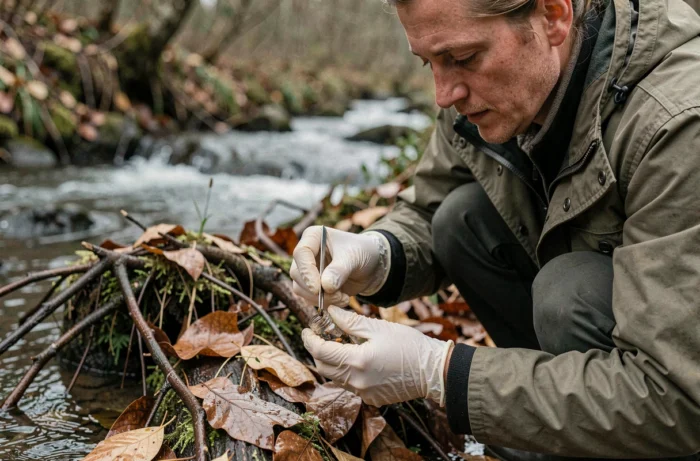
Collecting feces in the field presents specific constraints. Salamander droppings are small, degrade quickly due to humidity, and can easily be confused with those of other small amphibians or lizards. Visual identification remains tricky without prior training.
The preservation of samples is also a concern. The DNA contained in the feces fragments within a few hours at room temperature. Field protocols require rapid transfer to a preservation buffer or freezing, complicating campaigns in isolated forest environments.
Perspectives opened by molecular approaches
Despite these constraints, the potential remains considerable. Non-invasive fecal analysis avoids the need to handle or capture animals, a major advantage for a species protected in most European countries. Nocturnal and discreet, salamanders leave behind accessible study material without disturbance.
The combination of fecal metabarcoding with other sources of environmental DNA (stream water, forest soil) paves the way for cross-inventories of local biodiversity. Researchers could ultimately reconstruct complete trophic networks, from forest litter to the predators of the salamander itself.
The main challenge remains scaling up. For salamander droppings to become an operational monitoring tool, collection, preservation, and analysis protocols must be accessible to natural area managers, not just genomic laboratories. The standardization of pipelines like MAP is a concrete first step in this direction.