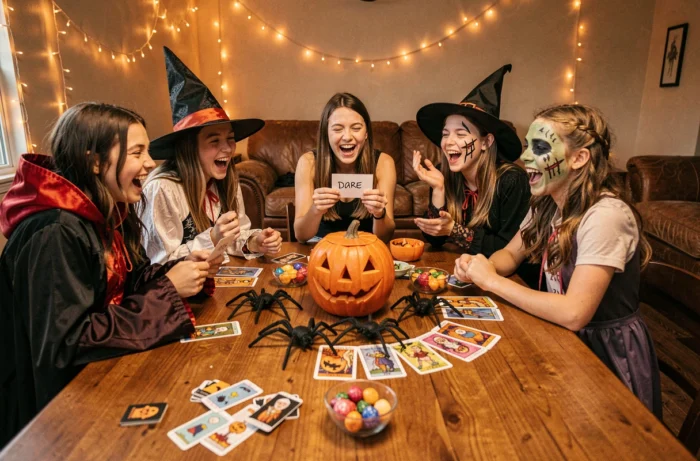
Organizing a Halloween party for teens is about finding the right balance between thrills, laughter, and group challenges. Classic children’s games no longer work, and overly passive activities aren’t enough to create lasting memories. What matters are Halloween games for teens where every participant is active, the suspense builds gradually, and no one is left as a reluctant spectator.
Here are ten concrete ideas, feasible without a huge budget, to transform a living room into a nighttime playground.
1. Home escape game with lock puzzles
No need for a commercial kit. Three combination locks, about ten clues hidden in the room, and a scenario written on a sheet are enough. The principle: players have a limited time to solve the puzzles and open a final chest.
For a Halloween atmosphere, anchor the scenario in a specific theme (mad scientist’s lab, witch’s grimoire). Each puzzle should physically lead to the next, not just chain riddles together. For example, a code found under a fake spider web opens a lock that releases a UV lamp revealing the next message.
Plan a backup clue every ten minutes to avoid frustration. At this age, a prolonged blockage can break the group’s momentum.
2. Murder mystery party with assigned roles
Each guest receives, upon arrival, a character sheet with a name, a secret, and a goal. One of them is the culprit, but no one knows who it is, not even them at first. Throughout the evening, clues are revealed at regular intervals.
If you’re looking for Halloween games for teens that keep everyone on edge for over an hour, the murder mystery party is the ideal format. The group must interrogate, bluff, and accuse. Plan a final voting phase where everyone designates their suspect.
Limit the roles to one secret per character to keep everything clear. Too many rules kill the fun of improvisation.
3. Nighttime treasure hunt with flashlights
The garden or even an apartment with dim lighting completely changes the atmosphere. Hide about ten glow-in-the-dark objects or small candy bags in strategic locations, each associated with a clue leading to the next.
The trick that works with teens: add a competitive element. Two teams, the same course, a timer. The fastest team wins the other team’s loot. This encourages collaboration instead of everyone searching on their own.
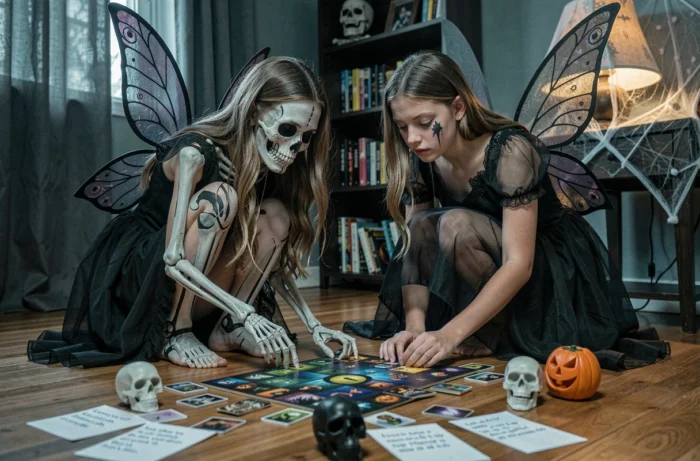
4. Horror-themed sound blind test
Compile about twenty excerpts: soundtracks from horror movies, famous screams from cinema, classic sound effects (creaking door, wolf howl). Players write down their answers on a sheet.
What makes this game suitable for teens is the possibility to mix genres. Slip in excerpts from horror comedies or well-known video games to surprise those who think they recognize everything. A good blind test alternates between obvious and tricky.
5. Themed FX makeup contest
Each duo draws a theme (open wound, zombie, burn, vampire bite) and has twenty minutes to do the makeup on their partner. The basic materials remain accessible: fake blood, light foundation, cotton, eyelash glue to attach textures.
The jury scores on three criteria: realism, creativity, and adherence to the theme. This format appeals to both those who love makeup and those who prefer to be the guinea pig. Remember to check for skin allergies before distributing products.
6. Reimagined “truth or dare” challenge
The principle of “truth or dare” is familiar, but the Halloween version replaces mundane actions with sensory challenges. Dipping a hand into a bowl of unidentified foods (cold spaghetti, gelatin, peeled grapes), tasting a mixture blindly, or miming a horror movie scene in front of the group.
Rule to establish from the start: each player can skip their turn without penalty. Some teens dislike textures or surprise contact, and forcing participation ruins the atmosphere for everyone.
7. Immersive Werewolf game with decor
The Werewolf card game already works well in its classic version. For a Halloween night, add a physical dimension: lights off during the night phase, LED candles placed in the center, and a game master narrating the story with sound effects from a phone.
With a group of eight to twelve teens, this format creates alliances, betrayals, and laughter. Add one or two home roles (the ghost who can spy on a vote, the witch who resurrects an eliminated player) to refresh the games.
8. Non-alcoholic cocktail workshop “cursed potions”
Each team has the same basic ingredients and must invent the most convincing potion, both visually and taste-wise. Ingredients that work well include:
- Grenadine juice and sparkling water for a “blood” effect with bubbles
- Coconut milk and green food coloring for a cloudy texture
- Violet syrup and skull-shaped ice cubes (silicone molds for a few euros)
The jury tastes blindly. The presentation of the glass counts as much as the taste: a potion name displayed on a label, a staging with dry ice smoke if you can find it.
9. Timed relay horror stories
One player starts a horror story. After sixty seconds, a sound signal rings, and the next player takes over, picking up exactly where the previous one left off. The goal: maintain narrative coherence while surprising the group.
This game reveals storytelling talents and creates absurd situations when someone inherits an impossible cliffhanger. To spice things up, impose a mandatory word to include in each segment (pumpkin, crypt, bat).
10. Horror Pictionary in teams
Prepare about thirty cards with words related to Halloween, divided into three levels:
- Easy: pumpkin, ghost, bat, spider web
- Medium: exorcism, werewolf, haunted mansion, potion
- Difficult: sleepwalking, curse, resurrection, ectoplasm
Each drawer has thirty seconds. Difficult words earn more points. The prohibition of speaking or miming makes the games intense, especially when you have to draw “sleepwalking” in half a minute.
These ten games cover different registers: suspense, creativity, competition, cooperation. The most effective approach is to vary the formats throughout the evening to maintain the group’s energy. Start with a physical game (treasure hunt, escape game), follow with a calm format (blind test, relay stories), then kick off with a challenge (makeup, Pictionary). The alternation between tension and laughter is what makes a Halloween night memorable long after the last candy.