
When you open your wardrobe at the beginning of autumn, the question isn’t about replacing everything. It’s about identifying the two or three pieces that will make a difference over the next six months. This season, the autumn-winter 2026-2027 fashion trends are reflected as much in the cuts and materials as in a regulatory framework that reshapes shopping habits.
Law Against Ultra-Fast Fashion: What Changes for Your Purchases
Law No. 2026-602 of July 8, 2026, directly targets brands that refresh their catalogs at a frantic pace. Specifically, it imposes a modulation of environmental contributions based on the volume of new products released on the market, and it requires online sales sites to display the manufacturing location of each garment.
Starting January 1, 2027, certain advertisements and influencer promotions will be prohibited for actors classified as ultra-fast fashion. You can find information on maisondemode.fr detailing these changes and their impact on upcoming collections.
For us, as buyers, this means two things. First, we will see the manufacturing origin displayed on product pages, making comparisons easier. Second, brands that focus on incentives to repair rather than repurchase will benefit from reduced contributions, and this savings can be passed on to prices.

Repair and Second-Hand: Fashion Trends That Last More Than One Season
We are no longer talking about a militant gesture reserved for the convinced. Repair is becoming a commercial service integrated into the customer journey. Brands like Uniqlo (with RE.UNIQLO Studio), Arc’teryx (ReBIRD program), and Salomon now offer dedicated spaces in-store for mending, customizing, or reselling used items.
The stated goal is to bring customers back to the store after the initial purchase. It’s a model shift that also concerns style: when you know a coat can be repaired, you invest more in a cut and material that age well.
How to Spot a Piece Suitable for Repair
- Visible or accessible seams, indicating that the garment was designed to be disassembled and resewn without distorting the shape
- A fabric with a sufficiently dense weight to withstand mending or patching without puckering
- The presence of a take-back or repair program mentioned on the label or online product page
The Future Consumer 2028 study by WGSN identifies a profile of consumers attracted to sustainability, repairability, and more streamlined wardrobes. Brands that track the lifespan and repairs (rather than just sales) will have a tangible advantage with this clientele.
Colors and Silhouettes for Autumn-Winter 2026: What We Keep, What We Test
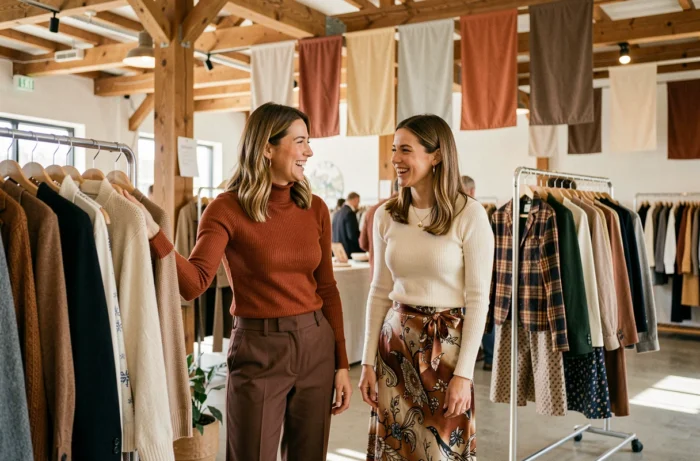
On the color palette side, the season’s runways confirm a return of muted tones: deep burgundy, forest green, buttery beige. Prints are not disappearing, but they are found on structured pieces (short jackets, straight skirts) rather than on flowing dresses like in spring.
This autumn’s silhouette relies on a contrast of volumes. A fitted top is paired with a loose bottom, or vice versa. The oversized sweater, which became popular in spring-summer 2026, remains relevant as long as it is worn with straight trousers or barrel jeans rather than leggings.
Three Concrete Combinations to Try This Season
A short trench over a ribbed knit midi dress, with slingbacks worn over thin socks. This street style-inspired look works well both at the office and outdoors, and feedback varies on the comfort of socks with slingbacks depending on the brands.
A structured blazer with a high collar paired with wide beige trousers and flat ankle boots. The key is the contrast between the rigidity of the top and the relaxed nature of the bottom.
A boucle wool vest worn alone over a simple t-shirt, with straight jeans. Boucle materials are making a strong comeback, and some brands are developing boucle yarns without synthetic fibers (made from wool and lyocell, for example, as offered by Armedangels for its autumn-winter 2026 collection).
Ethical Fashion and Traceability: Criteria to Check Before Buying
The European ban on destroying unsold textiles is gradually transforming the market. Unsold stock must be directed towards donation, resale, or recycling, which directly feeds the second-hand supply.
Before finalizing a purchase, we can now check a few concrete points:
- The manufacturing location, now mandatory on online product pages for brands selling in France
- The existence of a take-back or repair program associated with the brand
- The exact composition of materials (synthetic blends beyond a certain threshold complicate recycling at the end of life)
- The number of new references launched each month, a simple indicator to position a brand on the fast fashion scale
The European regulatory framework continues to evolve, with an expected strengthening of extended producer responsibility rules in the textile sector. Brands that anticipate these obligations gain transparency, and this is an increasingly visible selection criterion.
The fashion trends for this autumn-winter 2026 are not just about a color palette or a cut of pants. The legal framework, repair, and traceability are redefining how we compose a sustainable look. Focusing on repairable pieces, checking the manufacturing origin, and prioritizing a streamlined wardrobe is the most solid strategy to navigate the season without regrets.