
Attaching a belt without holes requires understanding the mechanism that replaces traditional perforations. Not all belts work the same way, and the type of buckle determines the fastening method, daily comfort, and tightening precision. Comparing the available systems allows you to choose the one that fits your body shape and usage.
Ratchet, pressure, or D-ring belt: which holeless fastening system to choose
The market offers several mechanisms to replace classic holes. Each relies on a different mechanical principle, with notable differences in terms of adjustment and compatibility.
| System | Fastening Principle | Adjustment Precision | Compatible with a standard strap |
|---|---|---|---|
| Ratchet | Notched rail under the strap, the buckle catches a notch | Very fine (notch by notch) | No, dedicated strap required |
| Lever buckle / quick release | Metal clamp that tightens the strap by pressure | Free, millimeter adjustment | Sometimes, depending on the width |
| D-ring | The strap passes through two rings and folds back | Free, manual adjustment | Yes, any flexible strap |
The ratchet system has become the most widespread variant of holeless belts. It offers a finer adjustment than traditional hole models thanks to the regular notching under the strap. However, it requires a specific strap: it is impossible to use your old leather strap without changing the fastening system.
The lever buckle works differently. It pinches the leather or fabric by friction, without a rail. Some brands offer it as a direct replacement for a prong buckle, provided the strap width matches. Knowing this tip for attaching a belt without holes simplifies switching from one system to another.
How to attach a ratchet belt: step by step
The ratchet mechanism often confuses users on the first try. The strap does not pierce; it slides.
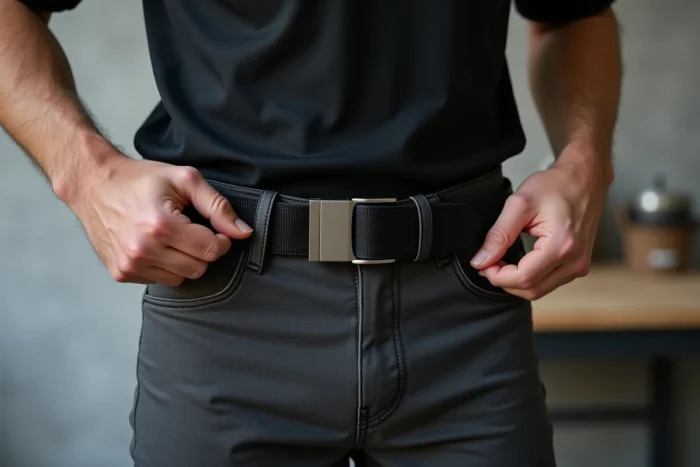
- Insert the end of the strap into the opening of the buckle, notched rail facing down (toward the body)
- Pull the strap until you achieve the desired tightness: the internal teeth of the buckle automatically engage on the rail
- To loosen or remove the belt, lift the small lever located under the buckle, which releases the teeth from the rail
The notched rail must always face against the pants, not outward. This is the most common mistake during first use. If the buckle does not “click,” turn the strap around.
The adjustment is done notch by notch, allowing you to tighten or loosen the belt after a meal, for example. This daily adaptability explains why these models appeal beyond just being a fashion accessory.
Cutting the strap to the right length
Most ratchet belts are sold in one size, with a strap longer than necessary. It needs to be trimmed.
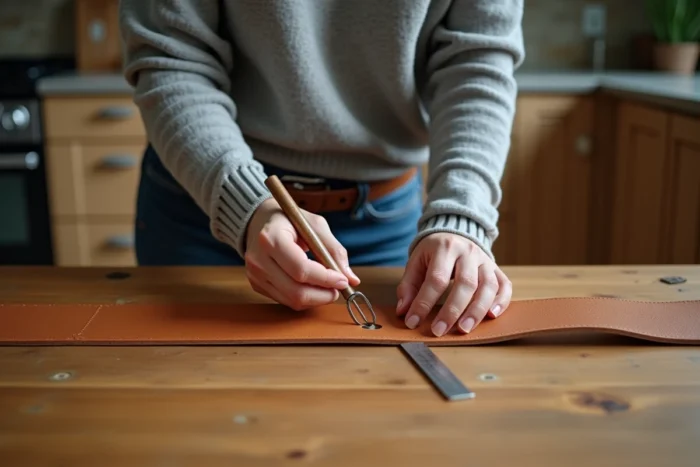
Remove the buckle (often secured by a screw or clip). Measure your actual waist size, add a few centimeters for margin, then cut the excess from the side opposite the rounded end. Reattach the buckle. A clean, straight cut ensures that the rail remains functional along the remaining length.
Can all belts become holeless?
The short answer: no. Compatibility depends on the type of buckle and the nature of the strap.
A classic prong belt (the metal rod that goes through a hole) cannot accommodate a ratchet mechanism. The notched rail is an integral part of the strap; it cannot be added afterward. Simply replacing the buckle is not enough; the entire buckle and strap must be replaced.
On the other hand, converting a prong belt into a D-ring belt is feasible. You just need to remove the original buckle and replace it with two D-rings of the correct width. The strap passes through both rings and then folds back on itself. This system works with any flexible material (leather, fabric, synthetic strap).
The lever buckle offers a compromise. Some models adapt to standard straps, provided the thickness of the leather does not exceed the clamping capacity of the clamp. Leather that is too thick or rigid will slip under pressure.
What limits conversion
- The width of the strap: each buckle accepts a specific width; a difference of a few millimeters prevents fitting
- The thickness of the leather: pressure buckles do not work well on thick leather like western belts
- The rigidity of the material: a very stiff strap does not fold properly in a D-ring system
Checking the width and thickness of the strap before buying a replacement buckle avoids returns and disappointments.
Holeless belts and wear: what changes with use
Classic hole belts quickly show signs of wear: the hole used daily becomes oval, and the leather deforms around the perforation. On a holeless belt, wear is distributed differently.
With a ratchet system, the notched rail undergoes regular friction. On lower-end models, the notches may dull after several months of intensive use, reducing the reliability of the grip. Full-grain leather straps resist better than reconstituted leathers or thin synthetic materials.
The lever buckle, on the other hand, exerts localized pressure on the strap. Over time, a pinch mark appears at the usual tightening area. This phenomenon is less visible than a deformed hole, but it exists.
The D-ring is the system that best preserves the strap, as the pressure is distributed over a larger surface. It is also the simplest mechanism to maintain: no moving parts, nothing to lubricate, nothing to replace.
Ultimately, the choice of system depends on what you expect: maximum precision with the ratchet, versatility with the lever, durability with the D-ring. Each mechanism meets a different need, and the classic hole belt is not always the one to seek to convert. Sometimes, starting with a strap and buckle designed for each other remains the most reliable solution.