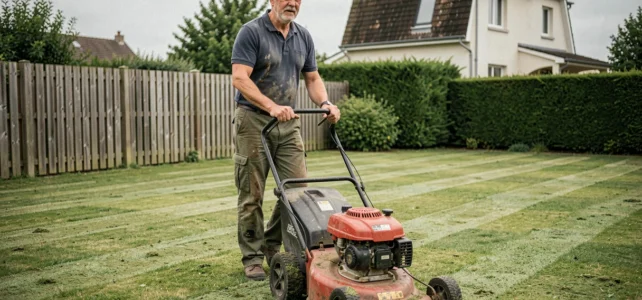
The power of a petrol lawn mower is not just a number on a technical sheet. Choosing the right power for a petrol mower involves considering several parameters related to the terrain, vegetation, and actual use of the machine. An undersized engine quickly becomes fatigued, overheats, and cuts poorly. An oversized engine adds weight to the device, consumes more fuel, and costs more to purchase and maintain.
Undersized Engine: The Main Cause of Disappointment
User feedback on entry-level models reveals a recurring pattern. A mower advertised for a given area is used beyond its capabilities, leading to accumulating negative reviews. The case of the Scheppach MP132-40 illustrates this phenomenon well: advertised for gardens up to 600 m², it is frequently pushed beyond its limits by its owners, who then notice a lack of power in dense grass.
This gap between actual capacity and daily use is rarely addressed in buying guides. Undersizing a mower is more common than oversizing it, and the consequences are direct: engine overheating, uneven cutting, premature wear of the blades and engine block.
Before looking at engine displacement or horsepower, the first question to ask is about the effective area to be mowed, adding a safety margin. A 500 m² area with sloped zones, thick grass, or frequent passages between obstacles demands as much from the engine as a flat 700 m² area. Consulting a guide on the power of a petrol mower helps refine this sizing based on concrete criteria.
Engine Displacement and Horsepower of a Petrol Mower: Two Data Points Not to Confuse
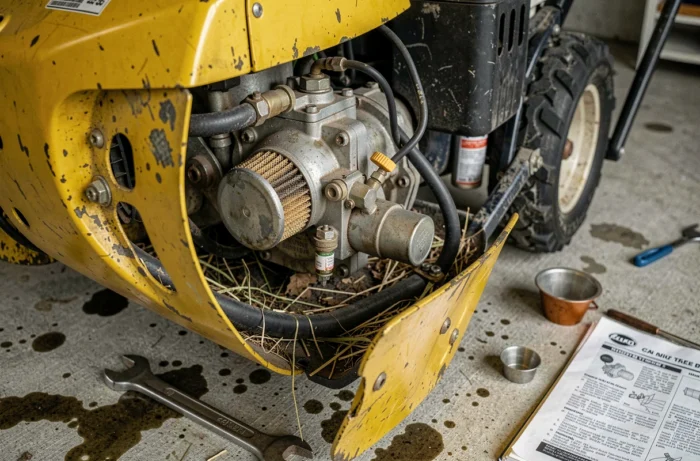
Engine displacement, expressed in cubic centimeters, corresponds to the total volume swept by the engine’s pistons. Power, expressed in horsepower (hp), reflects the mechanical energy actually delivered. A high displacement does not automatically guarantee proportional power: efficiency depends on the number of cylinders, the quality of combustion, and the design of the engine block.
Consumer-grade petrol mowers typically have single-cylinder engines. The most common models range from one to several cylinders depending on the range. With the same displacement, two engines from different brands can exhibit significantly different power outputs.
For the user, the most reliable data remains the horsepower, coupled with the cutting width. A powerful engine paired with a narrow cutting width will be underutilized. Conversely, a modest engine coupled with a generous cutting width will struggle in tall grass.
Terrain and Vegetation: The Real Power Criteria for Mowing
The size of the garden is the most frequently cited criterion, but it remains insufficient when considered alone. Two areas of the same size do not require the same power if one is flat with short grass and the other hilly with dense grass.
- A flat and regularly mowed area requires less engine power, even over a large surface. The mechanical resistance is low, and a mid-range model is sufficient in most cases.
- A sloped or uneven terrain continuously demands from the engine, especially if the mower is self-propelled. The transmission consumes part of the available power, reducing the energy dedicated to cutting.
- Tall, wet, or fibrous grass poses significantly more resistance to the blades. Dense grass is the factor that requires the most power reserve, more so than the area itself.
- Gardens with many obstacles (trees, flower beds, borders) require frequent maneuvers and restarts, which intermittently but intensely engages the engine.
The mode of propulsion also plays a role. A push mower uses all the engine’s power for cutting. A self-propelled mower distributes this power between cutting and driving the wheels. On a self-propelled model, planning for a higher power level compensates for this distribution.
Petrol Mower or Electric Alternative: The Power Question Changes

The market for robotic mowers and lithium-ion battery models is experiencing strong growth in Europe, with rapid adoption in France. This trend alters how the power question is posed. An increasing number of users no longer think in terms of horsepower or displacement, but in battery autonomy and mowing frequency.
Nevertheless, the petrol mower remains relevant for large areas, tall grass, and intensive use. The raw power of a petrol engine remains superior to that of most battery models under these conditions.
The choice is therefore not limited to “what thermal power to choose,” but rather to “do I really need a powerful petrol mower.” On a modestly sized, regularly maintained area, an electric model or a robot may render the power question secondary. However, on a terrain exceeding several hundred square meters with relief or vegetation constraints, the petrol mower remains the most suitable solution for demanding uses.
Discharge and Mulching: A Parameter That Affects Power Needs
The type of discharge for the cut grass directly influences the demand on the engine. Collecting in a bag requires a powerful airflow to suck up the blades, which engages the engine more than a simple side discharge.
Mulching, which involves finely shredding the grass to return it to the ground, requires additional mechanical effort. The blades rotate in a closed housing, and the grass must be cut multiple times before being expelled. Mulching requires a more powerful engine than simple discharge, and this point is often underestimated during purchase.
If you plan to use the mulching function regularly, incorporating this parameter into the power choice helps avoid disappointments. An engine that mows correctly in rear discharge mode may prove insufficient in mulching mode on the same area.
The sizing of a petrol mower’s power is based on a combination of intersecting factors, not on a single number. Area, relief, type of grass, mode of propulsion, and discharge system form a whole. Starting from the actual terrain, with its constraints, remains the most reliable method to avoid an unsuitable purchase.