
A gently sloping yard with raised flower beds, a wire fence, and gravel borders along the path: this is the kind of setup where the mower stops and the string trimmer takes over. Choosing the right model starts with looking at your garden as it is, not as you dream it in a catalog. The area matters, but the nature of the obstacles and the vegetation to be cut weigh more heavily in the decision.
String, blades, or cutting head: the cutting system that changes everything on the ground
People often think of the motor first. This is a mistake. The cutting system determines what you can actually do with the tool, and especially what you won’t be able to do.
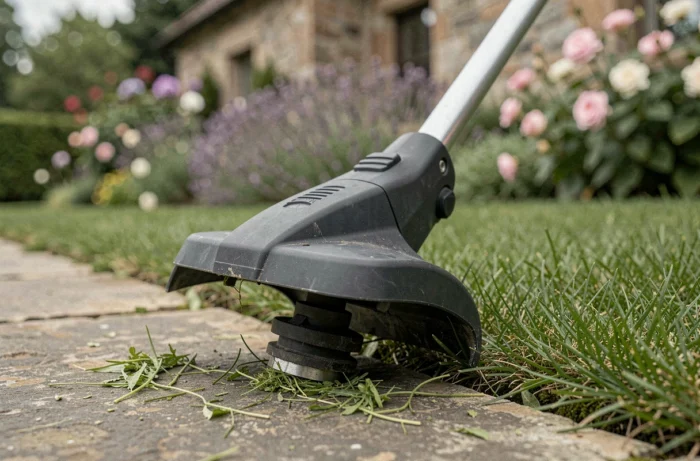
Nylon string remains the most common. It is suitable for soft grass, for finishing touches along a wall or path. On tall, wet grass, it breaks quickly and requires frequent rewinding. Rotating plastic blades hold up better against dense grasses, but they wear out when in contact with stone or concrete.
For woody vegetation (young brambles, ivy regrowth at the foot of a fence), you switch to a brush cutter with a metal blade. A classic string trimmer is not designed for this type of work, and forcing it reduces the motor’s lifespan. Detailed comparisons and field tests can be found on taille-bordure-warrior.com, which helps to distinguish the line between string trimmers and brush cutters based on the vegetation to be managed.
The diameter of the nylon string determines the cutting capacity: a thin string is sufficient for short grass, while a thicker string withstands tough grasses better. Checking compatibility with the cutting head before purchasing a replacement spool avoids surprises.
Battery, corded, or gas: adapting the motorization to the actual terrain
A city garden enclosed with less than two hundred square meters, with an accessible outdoor outlet, does not justify a battery model. A corded electric string trimmer remains lighter, starts immediately, and poses no autonomy issues.
As soon as the area expands or obstacles multiply (flower beds, trees, fences far from the house), the corded model becomes a constraint. The lithium-ion battery model offers a freedom of movement that significantly changes the way you work. You can navigate around flower beds without worrying about the cord, and go behind the shed without an extension cord.
Multi-tool battery platforms: a calculation to be made
Several manufacturers offer ranges where the same battery powers the string trimmer, mower, blower, and hedge trimmer. The savings are real if you already own a tool from the range. However, the actual autonomy strongly depends on the thickness of the vegetation and the frequency of cutting. On tall, wet grass, the battery drains much faster than what the product sheet indicates.
The gas model remains relevant for large plots or uneven terrain with thick vegetation. The extra weight, noise, and maintenance of the engine (spark plug, filter, oil-gas mixture for two-stroke engines) make it a choice reserved for real power needs, not a default choice.
Repairability and lifespan: what matters before the purchase price
A low-cost string trimmer for which you can no longer find the spool or battery after two years costs more than a model sold for a few dozen euros more with parts available for several years.
In France, electric mowers are subject to the reparability index, which evaluates technical documentation, ease of disassembly, and availability of parts. String trimmers do not yet appear as a distinct category in this system. This means that you must check yourself, with the manufacturer or retailer, whether key components can be ordered separately:
- The spool of string or the knife rotor, a wear part replaced several times per season depending on usage intensity
- The battery, whose capacity declines with charge cycles (prefer a removable model compatible with a wide range)
- The motor block and the protective cover, less frequently affected but costly to replace if the reference is not found
The European regulation 2023/1542 provides for a requirement for the disassembly of batteries starting in February 2027. Until then, some devices remain sold with sealed or semi-sealed batteries. Before purchasing a cordless model, ensure that the battery can be removed without special tools and that it is listed in the spare parts catalog.

Ergonomics of the string trimmer: weight, handle, and cutting width
The impact of weight on a trimming session lasting twenty to thirty minutes is often underestimated. A corded model generally weighs less than a battery model, which in turn weighs less than a gas model. But weight alone does not tell the whole story.
The distribution of weight and the position of the secondary handle determine real comfort. An adjustable telescopic handle prevents constant bending. An inclinable or pivoting cutting head allows you to work vertically for clean edges, then horizontally under a bench or low hedge.
The cutting width, often overlooked, influences the time spent on each pass. A generous width speeds up work on long stretches of lawn, but makes the tool less precise for narrow finishes between slabs or around rose bushes. Feedback varies on this point, as the ideal compromise depends on the garden’s configuration.
- For meticulous finishes (plant bases, lawn-patio junctions), a reduced cutting width offers more control
- For linear edges along a path or low wall, a larger width saves time
- A harness or shoulder strap relieves the shoulders as soon as the session exceeds fifteen minutes, especially with a gas model
The choice of a string trimmer rarely comes down to a single criterion. The vegetation to be cut guides the cutting system, the terrain configuration dictates the motorization, and the frequency of use makes the question of spare parts more or less urgent. A good string trimmer is one that you reach for without hesitation every week because it is suited to what you need, not one that sits in the garage because it is too heavy or too limited.