The Théâtre du Palais-Royal, designed in the Italian style with its three rounded balconies around the stage, rewards or penalizes the spectator based on their seating choice. The configuration of this historic venue creates disparities in visibility and comfort that online ticketing does not always clearly indicate.
Italian Geometry and Blind Spots at the Théâtre du Palais-Royal
The typical horseshoe layout of Italian-style theaters generates a paradox that we consistently observe: the side seats in the balconies lose part of the stage frame. At the Palais-Royal, the front boxes offer a tempting closeness to the actors, but the viewing angle cuts off the distant side stage left or stage right depending on the chosen side.
The central orchestra remains the safe bet for a complete reading of the staging. The rows located in the middle of the orchestra combine sufficient distance and eye level aligned with the stage. Too close, the upward angle strains the neck and flattens the perspective of the sets.
To identify the best seats at the Théâtre du Palais-Royal, one must think in terms of the line of sight relative to the center of the stage, not just in terms of ticket price category. A first-category seat at the far side of the first balcony has a worse view than a second-category seat centered in the second balcony.
Seat Comfort and Accessibility Constraints of the Venue
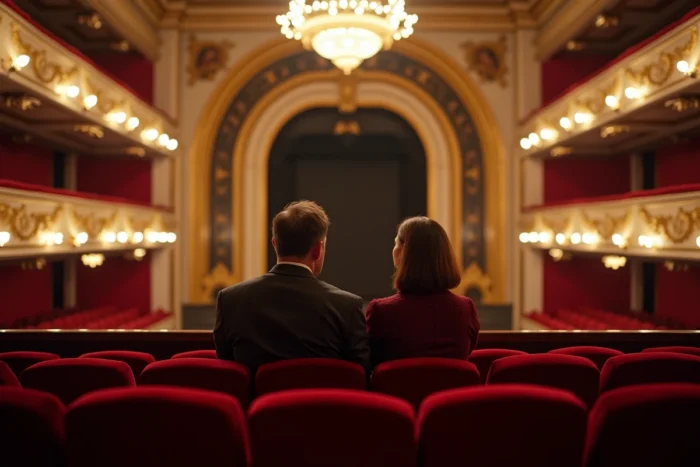
The theater dates back to 1783, and the spacing between rows reflects the dimensions of the time. Tall spectators will benefit from choosing an end of the row or the last row, as confirmed by some audience feedback appreciating the extra legroom at the back of the hall.
The building is not equipped for wheelchair access. There is an elevator, but it serves the floors for people with mobility difficulties, without allowing proper wheelchair access. This point, rarely mentioned on third-party ticketing platforms, is noted on the theater’s own page.
The cloakroom charges per item. Strollers, scooters, and bicycles are prohibited inside the venue. Planning to arrive light simplifies settling in, especially in the central rows where the passage is narrow.
Visibility Depending on the Show: Staging and Audience Interaction
Not all seats are equal from one show to another. A boulevard play with actors performing facing the audience forgives more for side placements than a production that exploits the depth of the stage.
The upcoming announced creation, “The Guide to the Perfect Gentleman Assassin,” illustrates this principle well. Its communication highlights an investigative experience where observing expressions and stage details conditions immersion. For this type of show, we recommend the central rows of the orchestra or the first balcony facing, where the reading of faces remains clear.
Plays driven by rhythm and humor, with actors projecting towards the audience, work well from the upper balconies. The distance visually compresses the stage, but the sound in this compact venue remains homogeneous, even in the last rows.
Criteria to Consider Before Booking
- The line of sight: prioritize central blocks rather than the lowest prices on the side, especially if the play relies on eye contact between actors
- The nature of the show: a musical or a highly visual performance requires sufficient distance to embrace the entire set, while a one-man show is best enjoyed up close
- Personal dimensions: the historical narrowness of the seats can turn an evening into a trial if the row is compact and the spectator is tall
- Arrival time: ticket collection occurs thirty minutes before the start, and the best positions in free access (when they exist) go quickly
Ticketing and Price Categories: Decoding the Seating Plan
The price category does not always reflect the actual quality of the seat. Online seating plans often group seats with very different visibility conditions under the same color. At the Palais-Royal, the first balcony facing and the first side balcony sometimes carry the same price label even though the experience diverges significantly.
We recommend cross-referencing the official ticketing plan with photos of the venue taken from different angles. Several shots show the view from the back balconies and confirm that the overhang remains moderate due to the compactness of the venue.
Kiosks and Last-Minute Ticketing
Parisian kiosks regularly offer discounted tickets for the Palais-Royal. These tickets often allocate the last rows of the orchestra or the sides of the second balcony. For an informed spectator, these locations remain quite usable in a venue of this size, provided they accept a slight lateral offset.
The proximity of the Louvre-Rivoli-Tuileries area allows for integrating the evening into a broader itinerary: covered galleries, restaurants under the arcades of the Palais-Royal. Arriving early gives time to scout the area and enjoy the atmosphere before heading to the air-conditioned hall.
Choosing a seat at the Théâtre du Palais-Royal hinges on details that the seating plan does not convey: the actual viewing angle, the eye level relative to the stage, the available legroom. It is better to have a well-centered second category than a first category at the end of the balcony. The compactness of this historic venue remains its main asset: even the most distant seats are never really far from the stage.