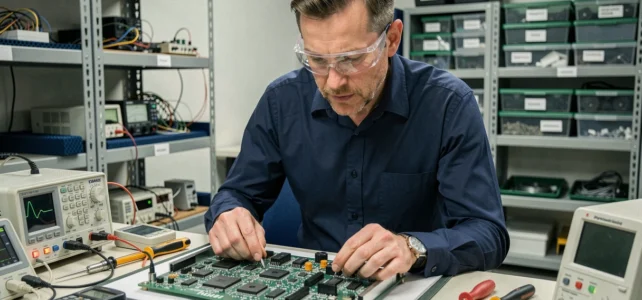
Electronic power architectures for the industry no longer follow the classic roadmap of generic converters. In 2026, the design of power supplies and conversion stages is driven by two converging forces: the rise of AI-dedicated data centers and the tightening of European regulations on the energy efficiency of wireless modules. These two dynamics are reshaping the priorities of industrial electronics design offices.
DC architectures and wide bandgap semiconductors: electronic power is changing paradigms
Major developments in electronic power are now dictated by the needs of AI data centers. The adoption of high voltage DC buses reduces conversion stages and associated losses, a decisive advantage when each rack consumes several tens of kilowatts.
SiC and GaN are no longer confined to automotive or telecom niches. We are seeing their extension to new power classes in industrial power supplies, with increased functional integration: driver, protection, and switching stage on the same substrate. This densification reduces the physical footprint of converters and simplifies thermal management.
Thermal adaptation is becoming a development axis in itself. Passive heat sinks are giving way to solutions with integrated heat pipes or direct liquid cooling on modules, including for applications that did not justify the cost two years ago. Find all the news on Ei Mag to follow these technical evolutions over the months.
Embedded AI in production: from pilot to real-time quality control
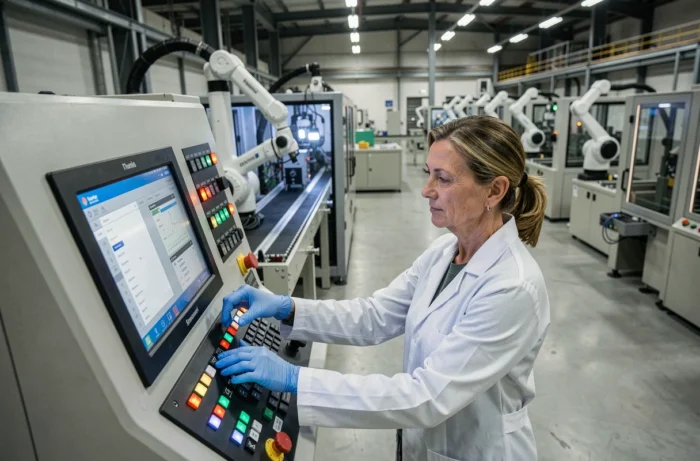
Artificial intelligence in the workshop has moved beyond the demonstration stage. ML models now drive online quality control, defect detection, dosing, and sorting on electronic manufacturing lines. The shift occurs when the model makes a decision without human intervention: rejecting a batch, adjusting a soldering parameter, recalibrating a placement machine.
This transition from pilot to workshop standard assumes a reliable data infrastructure. Smart sensors continuously feed local (edge) databases, and processing is done as close to the line as possible. The use of the cloud remains relevant for periodic retraining of models, but not for real-time decision-making where latency is prohibitive.
Points of caution for industrial deployment
- The quality of the training dataset conditions the reliability of the model. A biased dataset (overrepresentation of one type of defect, absence of component variants) produces an unmanageable false positive rate in production cadence.
- Integration with existing MES remains the main bottleneck. Proprietary protocols from certain equipment manufacturers hinder interoperability, a problem that the adoption of open standards like OPC UA is beginning to solve.
- Model maintenance is a recurring cost: data drift, change of component supplier, process modification. Without an automated retraining pipeline, performance degrades within a few months.
Industrial wireless regulation: the RED amendment and its consequences
The RED (Radio Equipment Directive) amendment from the European Union imposes stricter limits on the energy efficiency of wireless modules in 2026. For IIoT integrators, this means a revision of radio component choices: high standby consumption Wi-Fi and Bluetooth modules become non-compliant without firmware redesign or hardware replacement.
We recommend auditing the modules currently deployed on industrial sensor networks. Manufacturers who anticipated the directive already offer low-consumption versions in listening mode, but the unit cost is not negligible at the scale of a factory equipped with several thousand nodes.
This regulatory constraint also accelerates the adoption of native low-power protocols (Thread, Wi-SUN) at the expense of less optimized historical solutions. The choice of wireless protocol is becoming a standalone purchasing criterion, alongside bandwidth and range.

Open interoperability: a purchasing criterion that redefines ecosystems
Interoperability is no longer a marketing argument. It conditions the ability to evolve a production line without vendor lock-in. OPC UA, MQTT, and standardized REST APIs are becoming prerequisites in the specifications for industrial equipment.
This trend affects both programmable logic controllers and SCADA systems or edge gateways. Equipment that cannot natively communicate with an open bus generates integration costs that negate any potential price advantage at purchase.
What this concretely changes
Historical automation suppliers are adapting their ranges by integrating open software connectors. For users, the benefit is measured over the lifecycle: replacing a sensor without complete system reconfiguration, adding an analysis module without proprietary middleware, migrating to a new supervisor without loss of historical data.
Order givers who specify interoperability from the outset significantly reduce their software maintenance costs over the operational lifespan. This is a trade-off that weighs more heavily than the unit price of the component.
Industrial electronics in 2026 is structured around tangible constraints: regulated energy efficiency, DC architectures imposed by AI loads, and interoperability required by operators. Design offices that integrate these three parameters from the specification phase save time on certifications and avoid costly design rework downstream.