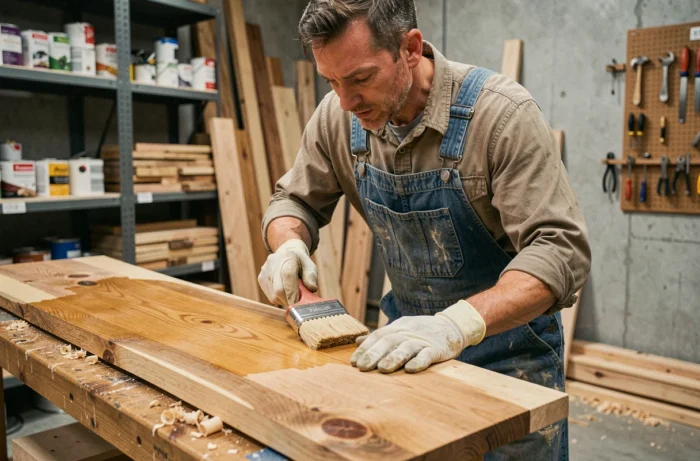
On a south-facing Douglas wood cladding, a classic stain rarely lasts more than two seasons before it starts to powder. Polyurethane changes the game: the resin forms a flexible film that withstands the wood’s expansion cycles without cracking. It is in this context that the Parkside polyurethane stain attracts the attention of craftsmen looking for a reliable product without blowing their project budget.
Polyurethane resin and wood penetration: what makes the technical difference
People often confuse stain and varnish. A stain penetrates the fibers, while a varnish remains on the surface. The Parkside polyurethane stain combines both approaches: it deeply impregnates the wood while leaving a semi-film-forming protective film on the surface.
This polyurethane film provides superior mechanical resistance compared to alkyd stains. On a gate or garden fence, there are fewer signs of abrasion after a winter. Outdoor carpentry professionals appreciate this performance, especially on softwoods like pine or spruce, which absorb quickly but also deteriorate just as fast without proper protection.
Another point to note: recent polyurethane formulations, often water-based, comply with new European regulatory constraints. Since August 6, 2026, Regulation (EU) 2023/1464 amending REACH imposes a formaldehyde emission limit of 0.062 mg/m³ for wood-based articles intended for indoor use. Well-formulated water-based polyurethane stains emit less than solvent-based stains, giving a concrete advantage to professionals finishing interior woodwork.
On site, the Parkside polyurethane stain for wood is chosen for both its ease of application with a spray gun and its durability on exposed structures.
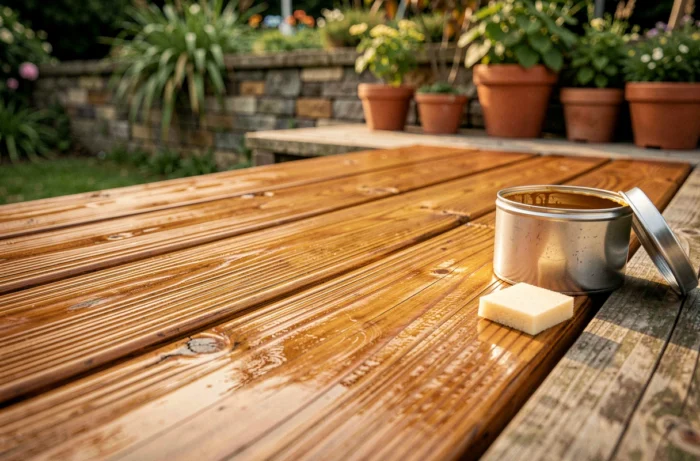
Parkside stain on site: application conditions and field feedback
Applying a polyurethane stain is not done like a classic glycerol stain. The Parkside product is applied with a wide brush, a lacquer roller, or a low-pressure paint station. On renovation forums, several users mention good performance with the station, with little mist and a uniform finish.
Surface preparation: a step that professionals never overlook
On new wood, sanding with 120-grit paper is sufficient before the first coat. On gray or previously treated wood, it is necessary to strip or de-gray first, then sand. Skipping this step reduces adhesion by half, regardless of the product used.
Between coats, the indicated drying time should be respected (varies according to temperature and humidity). Feedback varies on this point: some craftsmen apply the second coat after a few hours in summer, while others prefer to wait a full night to avoid solvent rise.
Number of coats and final finish
Two coats are the minimum for durable outdoor protection. Three coats on highly exposed areas (pergola posts, top of railings) significantly extend the lifespan of the treatment.
The finish remains satin and reveals the wood grain, distinguishing the stain from an opaque paint. On woods with pronounced grain like oak or larch, the result highlights the natural veining.
Outdoor or indoor: when regulations influence the choice
Regulation REACH 2023/1464 provides exemptions for products intended strictly for outdoor use. Specifically, a stain applied to a terrace or garden shed is not subject to the same emission thresholds as a stain applied to interior woodwork.
This distinction matters for professionals working on both types of projects. A single versatile product simplifies stock management: if the Parkside stain meets indoor thresholds, it is all the more suitable for outdoor use. This way, there is no need to multiply references in the workshop.
- Indoor use: check that the product meets the limit of 0.062 mg/m³ (furniture, wood articles) or 0.080 mg/m³ (other articles) according to REACH entry 77.
- Outdoor use: formaldehyde thresholds do not apply, but UV and moisture resistance remain the primary criteria.
- Mixed use (verandas, covered pergolas): prefer a product compliant with both requirements to avoid non-compliance on a partially enclosed structure.

Parkside quality-price ratio: what professionals really compare
Craftsmen do not judge a stain solely by the price of the container. The calculation is made per square meter protected, taking into account the number of coats required and the actual yield of the product.
The Parkside polyurethane stain is positioned below premium brands like V33 or Xyladecor, while offering a comparable polyurethane film. On a fencing project of several dozen linear meters, the budget difference becomes tangible without sacrificing durability.
What holds back some professionals is availability. Parkside is a brand primarily distributed through a network of large DIY stores, which can pose problems for regular supply on large projects. However, for an individual or a craftsman dealing with moderate volumes, this distribution channel remains perfectly suitable.
- Yield per liter: to be checked on the technical data sheet, but comparable to mid-range polyurethane stains.
- Color range: generally more limited than V33 or Bondex, which may influence the choice on projects requiring specific shades.
- Ease of touch-up: the polyurethane film can be sanded and recoated without complete stripping, a valuable time-saving in maintenance.
The choice of a polyurethane stain always depends on the substrate, exposure, and overall budget. Parkside meets the technical expectations of professionals on the majority of common wood projects, with a pricing position that makes it accessible without compromising the resistance of the protective film.