When replacing an aging oil boiler with a pellet system, the first surprise does not come from the fuel bill. It comes from the silo: where to put it, what capacity to plan for, how to manage bulk delivery. Pellet heating requires rethinking the organization of a boiler room even before discussing savings or ecology.
Pellet storage and installation constraints: what conditions the entire project
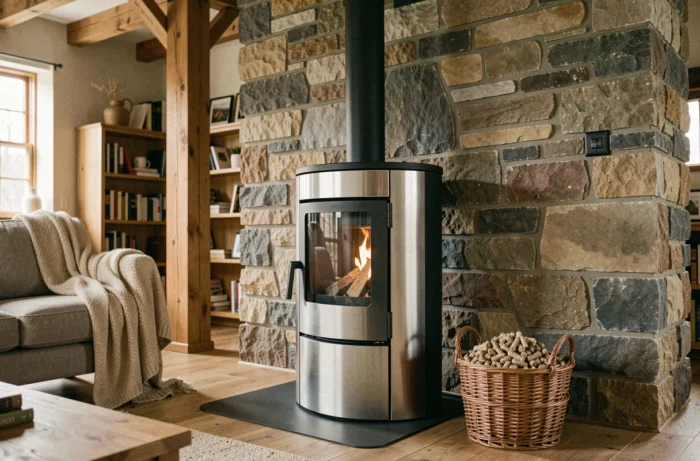
A pellet stove connects to an existing flue and requires only a small space for a few bags. A pellet boiler, on the other hand, needs a dedicated silo, often installed in an adjoining room or a dry basement area.
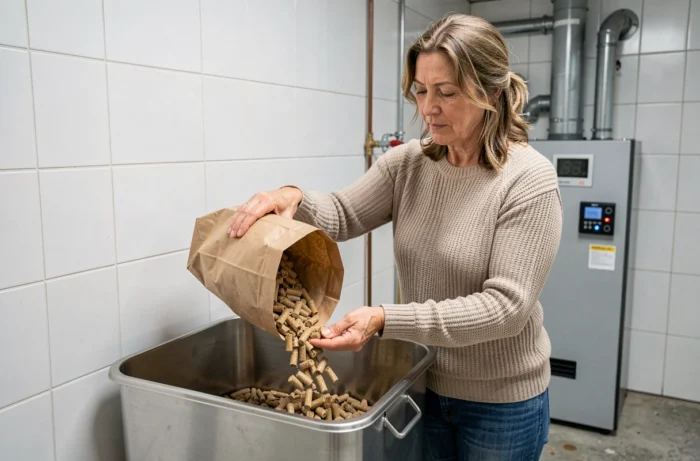
Humidity is the main enemy of stored pellets. Therefore, we check the tightness of the room, the ventilation, and avoid any direct contact between the bags and the bare concrete floor.
The choice between bulk and bags determines the price per MWh. According to the ADEME price survey 2024, retail bagged pellets cost about €80/MWh, while bulk is significantly cheaper. The difference often justifies the investment in a textile or masonry silo, provided there is truck access for delivery. Detailed information on formats and supply chains can be found on chauffage-pellets.org, which also lists sales points by region.
Actual cost of wood pellets compared to oil and gas
The price of pellets peaked sharply in 2022, followed by a 33% drop between 2023 and 2024 for retail bags. This volatility necessitates a nuanced view of any promise of automatic savings.
To compare correctly, we consider the cost per useful kWh, not the price per ton. The efficiency of the device comes into play, which reduces the amount of fuel needed compared to a traditional log insert.
What shifts the calculation
- The purchase format: bulk delivered at the beginning of summer is significantly cheaper than bags bought retail in the middle of winter. Anticipating the order changes the game.
- The sizing of the device: an oversized stove runs under load, consumes more, and clogs up faster. A prior thermal calculation is necessary.
- The insulation of the home: in a poorly insulated house, no fuel will be truly economical. Insulating before changing heating remains the priority.
Returns, however, vary by region and pellet supplier.
Carbon footprint of pellets: why pellets are not neutral but remain relevant
Wood pellets come from sawmill residues (sawdust, shavings) transformed by compression, without the addition of glue or chemical binders. This origin makes it a product derived from the valorization of industrial waste, which limits the impact on direct forest resources.
Over the complete cycle, the CO2 emitted during combustion corresponds to the carbon absorbed by the tree during its growth. The net balance is therefore much better than that of oil or gas. However, it is necessary to account for transport, industrial drying, and pellet manufacturing, which consume energy.
Limits to be aware of
The origin of the pellet weighs as much as its calorific value in the ecological equation. A locally produced pellet generates a more favorable carbon balance than an imported pellet. Checking certification (NF, DINplus, or ENplus) provides an indication of traceability.
Fine particle emissions remain a topic of concern. Recent devices, compliant with Écodesign standards, significantly reduce these emissions compared to older log stoves. Replacing an open fire with a high-performance pellet stove improves indoor and outdoor air quality.

Financial aid in 2025-2026: decreasing amounts but cumulative schemes
The amounts of MaPrimeRénov’ for wood stoves and boilers have decreased by 30% since January 1, 2025. This reduction changes the payback time, especially for households with intermediate incomes.
Several schemes remain cumulative:
- Energy Savings Certificates (CEE), paid by energy suppliers, with amounts varying according to the climate zone and the installed device.
- Reduced VAT on purchase and installation, applied directly by the installer.
- Zero-interest eco-loan, accessible without income conditions to finance the remaining costs.
Despite the decrease in aid, the French market for pellet devices is on the rise: 125,520 units sold in 2025, which is 24% more than in 2024 according to Observ’ER. Pellet stoves have increased by 35% during the same period. This resurgence shows that the economic calculation remains favorable for the majority of projects, provided the installation is properly sized and an appropriate supply is chosen.
Heating with pellets is not just a choice of fuel. It is a complete system, from the silo to the flue, that requires consideration of housing, storage, and the local supply chain. When these parameters are aligned, pellets offer a solid compromise between operating costs and environmental impact.