
Buying a plot of land is buying a promise. The promise of being able to build, develop, or resell under good conditions. A land review allows you to verify if this promise holds up, by cross-referencing data that neither the seller nor the advertisement spontaneously presents. The real issue is not just whether the parcel exists legally: it is about understanding what it will cost tomorrow, in taxes, urban planning constraints, and cadastral surprises.
Property Tax and Zoning: What Matters After Signing
Most buyers focus on the purchase price. They forget that property tax, zoning, and development rules determine the real cost of a plot of land over time.
A plot classified as agricultural land does not simply transform into a buildable zone upon request. If the local urban plan (PLU) evolves, the taxation follows. Zoning conditions both buildability and future taxation. Consulting a land review before purchase helps identify these parameters before they become constraints.
Have you ever noticed that two neighboring parcels can have very different property taxes? This often relates to their cadastral classification, which reflects land use and not just surface area. Adopting the land review reflex before investing helps identify these discrepancies early in the search phase, before any negotiation.
Cross-Referencing Cadastral Plans, Property Values, and Urban Planning Documents
Consulting a single source is not enough. The cadastral plan shows the boundaries of the parcel and its area, but it does not provide information on the prices practiced in the neighborhood or on the easements affecting the land.

To make a reliable purchase decision, three types of information must be cross-referenced:
- The cadastral plan, which identifies the parcel by its references and geographical boundaries. It serves as a basis, but it does not guarantee property rights on its own.
- The property values from the DVF (Demandes de Valeurs Foncières) database, updated twice a year, which records actual sales parcel by parcel. It allows for comparing the asking price with recent transactions in the area.
- The urban planning documents (urban planning certificate, PLU, risk assessment), which specify what can be built, the environmental constraints, and the development projects planned by the municipality.
A plot that looks attractive on paper can become a trap if the PLU prohibits the intended use. The land review aggregates this data to provide a comprehensive view, where each source taken in isolation tells only part of the story.
Cadastral Changes: Anticipating Changes in Land Value
The cadastre is not fixed. Municipalities regularly redraw parcel boundaries, modify classifications, and revise the calculation bases for property tax. A plot bought in a quiet area may find itself on the edge of a development project that alters its value, in either direction.
The DVF database allows for spotting recent changes in the neighborhood. If several nearby parcels have changed hands in a short time, it may signal a subdivision project, a modification of the PLU, or a change in the zoning designation. This weak signal, invisible in a standard advertisement, becomes visible when consulting land data.
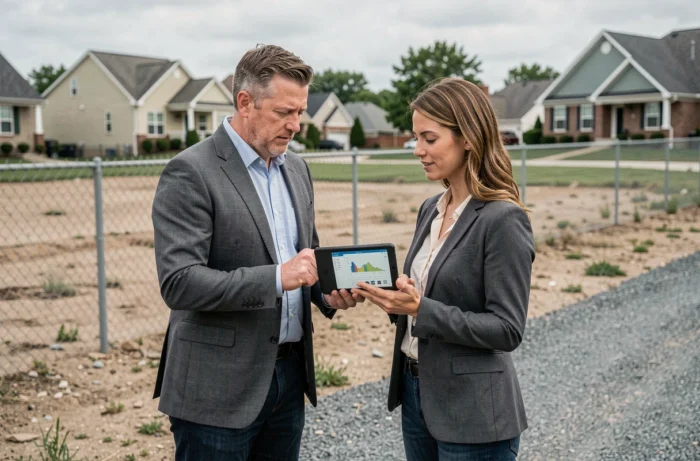
Buyers who do not verify these changes take a concrete risk. A cadastral reclassification can lead to a significant increase in property tax, sometimes as soon as the year following the purchase. Checking the cadastral history protects against unexpected tax increases.
Urban Planning Certificate and Risk Assessment: Two Documents to Demand
The urban planning certificate is the document that confirms what the land allows in terms of construction. There are two types: the information certificate (CUa), which provides the general applicable rules, and the operational certificate (CUb), which specifies whether a specific project is feasible on the parcel.
Why does this distinction matter? Because a plot may be theoretically buildable (favorable CUa) but unsuitable for your specific project (unfavorable CUb). For example, setback, height, or public utility connection rules may render a single-family home impossible on a parcel that is classified as buildable.
The risk and pollution assessment (ERP) completes the picture. This document, mandatory during the sale, lists:
- The natural risks (flooding, landslides, seismic activity) that affect the parcel.
- The technological risks related to the proximity of industrial facilities.
- The soil pollution, which may require decontamination work before any construction, directly impacting the project budget.
An unfavorable risk assessment does not block the sale, but it radically changes the economic calculation. Compliance or decontamination works can represent a significant portion of the total budget. It is better to know this before signing.
How the Land Review Changes Price Negotiation
Having precise land data changes the power dynamics with the seller. When a buyer arrives with comparable sales from the DVF database, PLU constraints, and the cadastral history of the parcel, the discussion is no longer based on impressions but on facts.
A plot listed at a high price in an area where recent transactions are significantly lower loses its commercial credibility. Conversely, an undervalued plot in a changing area can represent an opportunity, provided that it is verified that the zoning will indeed allow the intended use.
The land review transforms a buying intuition into a documented decision. It does not replace the notary or the land surveyor, but it intervenes upstream, at the moment when comparing several plots and when needing to eliminate those that present hidden risks. Buying land without having cross-referenced this data is to accept discovering unpleasant surprises after signing.