
Supporting an elderly person on a daily basis relies on a set of devices, services, and contacts, the knowledge of which determines the quality of the support provided. Identifying the right resource at the right time, among human assistance, public funding, and digital tools, remains the main obstacle for families and caregivers.
Home autonomy services: the overlooked brick of staying at home
Competitors speak of home assistance in broad terms. A more recent category deserves to be distinguished: home autonomy services (SAD). Listed on the MonParcoursHandicap.gouv.fr portal, these services go beyond traditional housekeeping assistance.
A SAD provides comprehensive support that combines essential daily living activities, coordination among healthcare professionals, and preventive actions. This structuring facilitates the quick connection of families with a single contact person, capable of organizing the entire home care journey.
To locate a SAD near the home, official directories such as servicesalapersonne.gouv.fr or Ma Boussole Aidants list their contact details by department. Consulting the senior resources from Passez l’info also allows for centralizing useful information without multiplying searches across several sites.
Digital information portals for seniors and their caregivers
The 2025 annual report from CNSA explicitly positions the national portal For the Elderly and the Mon Parcours Handicap site as national reference sites to ensure a seamless information journey. These two platforms cover rights, financial assistance, and local solutions.

The MaPrimeAdapt’ platform, launched in 2024, is another digital tool to be aware of. It allows for submitting a grant application to adapt one’s home (secure shower, stairlift, widening of doors) via an online form, with a certified advisor who follows the case.
The Local Information and Coordination Center (CLIC) remains the nearby physical point of contact. Each CLIC offers free reception, needs assessment, and guidance towards suitable services. Their territorial network makes them a complementary entry point to web portals, useful for individuals who are not comfortable with digital tools.
Financial assistance for autonomy: criteria and articulation
Three main financial mechanisms structure support for seniors living at home. Their articulation is rarely explained clearly.
- The Personalized Autonomy Allowance (APA) finances a personalized assistance plan after assessing the level of dependency by a medico-social team from the departmental council. It covers human assistance, technical aids, and day care.
- The Home Maintenance Assistance (AMD), offered notably by the public service and certain pension funds, targets autonomous retirees (GIR 5 and 6) for one-off services: housekeeping, meal delivery, home adaptation work.
- MaPrimeAdapt’ covers part of the home adaptation work. It can be combined with the APA under certain conditions, but not with other renovation aids for the same work.
A common mistake is to apply for the APA when the person still falls under GIR 5 or 6, which leads to a refusal. In this case, the AMD or assistance from complementary pension funds constitutes the right entry point.
Preventing loss of autonomy: nutrition and adapted physical activity
Prevention is the neglected aspect of research on supporting seniors. Families seek solutions when the loss of autonomy is already established, whereas simple actions can significantly delay dependency.
From a nutritional standpoint, needs evolve with age. Protein intake must be maintained or even increased to limit muscle loss (sarcopenia). Vitamin D and calcium remain nutrients to monitor, especially for individuals with limited sun exposure.
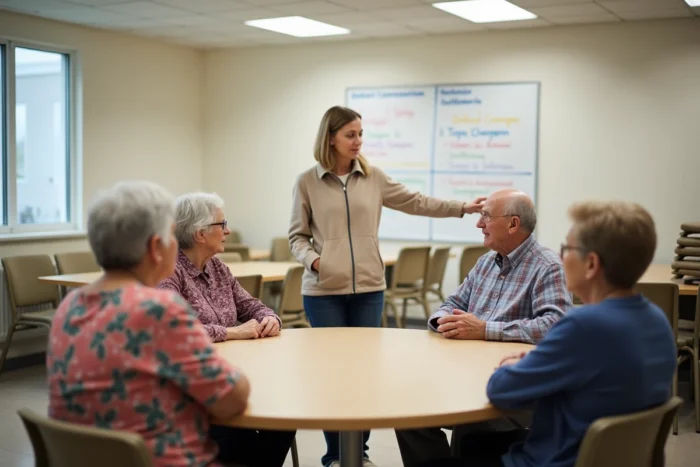
Adapted physical activity is not limited to walking. Balance and muscle strengthening workshops, often offered by pension funds or mutuals as part of prevention programs, reduce the risk of falls. The site Pour Bien Vieillir, run by pension funds, references this type of activity by geographic area.
Role of the family caregiver: recognizing limits and finding support
The family caregiver typically provides the majority of support for an elderly person experiencing loss of autonomy. This burden has documented consequences on the physical and psychological health of the caregiver.
Several forms of respite exist but remain underutilized:
- Day care in facilities, partially funded by the APA, allows the elderly person to benefit from supervised activities while the caregiver takes a break.
- The right to respite, included in the APA assistance plan, finances home relief hours or temporary accommodation when the caregiver reaches a threshold of exhaustion.
- Caregiver support platforms, linked to CLICs or hospitals, offer support groups and free psychological assistance.
A caregiver who exhausts themselves jeopardizes the home care of the person they support. Identifying warning signs (sleep disturbances, persistent irritability, neglecting their own care) and seeking relief before a breakdown is an integral part of the support process.
Access to resources for seniors relies less on their existence, which is now relatively comprehensive, than on the ability of families to identify these services and articulate them well. Starting with a CLIC or a national portal, then refining based on the level of autonomy and territory, remains the most reliable approach to building suitable support without wasting time.