
A co-ownership of two lots presented as “without common areas” remains, under French law, a full co-ownership. Each lot must necessarily include a share of the common areas, even if reduced to the strict minimum: the land, the structural work, or a simple shared access. This legal reality triggers a set of obligations that co-owners regularly underestimate.
Mandatory share: why co-ownership without common areas does not legally exist
French law prohibits a co-ownership lot from being composed solely of private areas. The law of July 10, 1965, requires that each lot includes a fraction of the common areas, expressed in thousandths. Even when two owners occupy distinct buildings on the same plot, the land itself constitutes a common area.
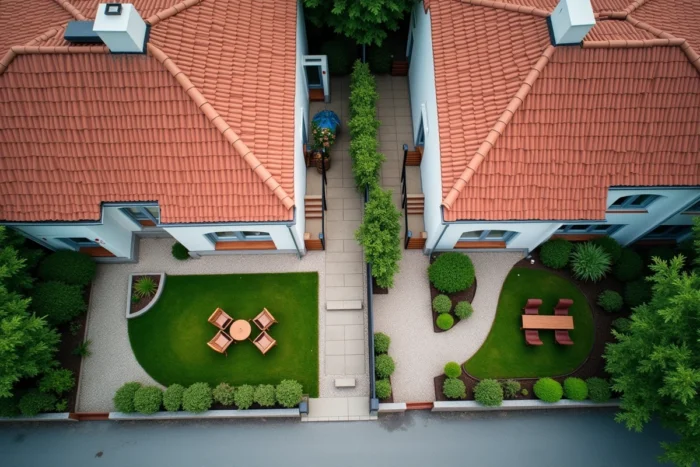
This configuration, common in semi-detached houses or small divided buildings, creates an illusion of independence. Co-owners manage their building as if they were in individual ownership, without calling for charges or holding meetings. The legal reality is different: as soon as a common element exists, however minimal, the co-ownership status applies in full.
The configuration of a co-ownership of 2 lots without common areas in practical terms thus requires precisely identifying these residual common elements in the co-ownership regulations and the descriptive state of division. Without this clarification, the thousandths remain poorly defined and the legal obligations ignored.

Legal regime of co-ownership of two lots: articles 41-13 to 41-23
Ordinance No. 2019-1101 of October 30, 2019, introduced a specific regime for co-ownerships composed of two co-owners, codified in articles 41-13 to 41-23 of the 1965 law. This regime is neither confused with the common law of classic co-ownerships nor with the simplified regime for small co-ownerships provided for in articles 41-8 and following.
Optional general assembly under conditions
In a two-person co-ownership, decisions can be made by written agreement between the co-owners, without formally convening a general assembly. This mechanism significantly eases daily management, provided that both parties agree.
When a disagreement arises, each co-owner retains the right to convene a meeting in the usual forms. The absence of a meeting does not exempt from formalizing decisions in writing, under penalty of having their validity contested.
Unilateral decisions and joint decisions
Some decisions regarding private areas can be made unilaterally by the concerned co-owner. Decisions affecting common areas, even reduced to the land, require the agreement of both parties.
This distinction becomes problematic when co-owners do not agree on the common or private nature of an element. A separating wall, a passing pipeline, or shared access can generate conflicts that the co-ownership regulations did not anticipate.
Administrative obligations applicable even without current charges
The absence of called charges does not mean the absence of obligations. Several legal requirements apply to any co-ownership, regardless of its size or the nature of its common areas.
- Registration in the national register of co-ownerships: every co-ownership must be registered, under penalty of financial sanctions. Micro-co-ownerships of two lots are not exempt from this.
- Appointment of a syndic: even if voluntary, a syndic must be formally appointed. One of the two co-owners can assume this role, but the appointment must be formalized.
- Opening a separate bank account in the name of the co-ownership syndicate, distinct from the personal accounts of the voluntary syndic.
- Establishment of a works fund, even if no work is planned in the short term. The ALUR law imposes this fund on all co-ownerships.
Ignoring these obligations exposes the syndicate to fines and complicates any future sale. A notary handling a transaction will require the co-ownership’s compliance before finalizing the deed.
Risks of blockage and recourse between two co-owners
Co-ownership of two mechanically creates a risk of blockage. With two voices, any decision requiring a majority becomes impossible without consensus. This situation differs radically from a classic co-ownership where coalitions can form.
The blockage manifests in concrete situations: necessary facade work refused by one, urgent roof repairs without agreement on funding, or disagreement on the use of common land. In these cases, the law provides for the referral to the judicial court to appoint a provisional administrator or authorize urgent works.
Urgent works: the co-owner can act alone
Articles 41-13 to 41-23 provide that in the event of a proven emergency (risk to the safety of persons or the preservation of the building), a co-owner can undertake works without the agreement of the other. They must then justify this urgency and account for the expenses.
This possibility of unilateral action serves as a safety valve, but it remains framed. Works undertaken without real urgency can be contested and lead to partial reimbursement.
Co-ownership insurance and liability on common land
Even reduced to the land, the common area engages the liability of the syndicate. An accident occurring in this space (falling tree, collapse of a retaining wall) engages both co-owners jointly. Taking out co-ownership insurance remains necessary, even when the common areas seem insignificant.
This insurance covers the civil liability of the syndicate and damages to third parties. It is distinct from the individual home insurance of each co-owner, which only protects private areas.
The management of a two-lot co-ownership rests on a paradox: the less visible the common areas are, the more co-owners neglect their obligations. The land, the structural work, or a simple shared passage are enough to maintain the co-ownership status and all the constraints that arise from it.