
A newborn changes diapers between eight and twelve times a day. Choosing the right Pampers diaper for their first weeks of life is not just about grabbing the first pack on the shelf. Three sub-ranges coexist within Pampers for little ones, and their differences lie in concrete details that affect skin comfort and umbilical cord management.
Umbilical cut and first days: a criterion that few parents anticipate
Have you noticed that little crescent-shaped notch on the front of some size 0 or 1 diapers? That’s the umbilical cut. It prevents any friction on the stump of the cord, which typically takes one to three weeks to fall off.
The Pampers New Baby range has been designed for this specific period. Its design targets the first days of life with this cut and a contact layer suitable for skin that has never been exposed to a diaper before.
Pampers Premium Protection also offers this cut in its smallest sizes. The difference lies elsewhere: Premium Protection is available up to size 6, allowing the same softness technology as the baby grows. New Baby, on the other hand, only covers the very first weeks. To better understand the differences between Pampers diapers, one must look beyond the simple size number.
The third option for newborns is Pampers New Baby Sensitive. This version further reduces additives and uses softer materials, intended for skin that is already reddened or particularly reactive from birth.
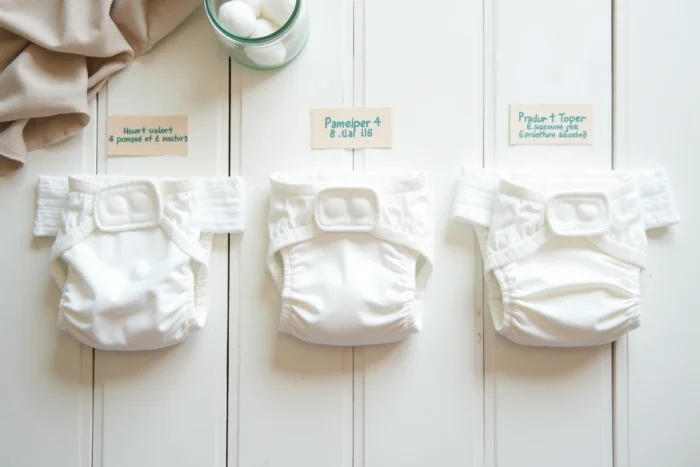
Pampers Premium Protection or Baby-Dry for newborns: two absorption logics
Why does this choice between these two ranges come up so often in discussions among parents? Because they meet two different needs, and confusing them leads to disappointments.
Premium Protection: softness as a priority
Premium Protection focuses on skin contact. Its inner layer is designed to limit irritations, making it the recommended range in maternity wards. Absorption remains effective, but it is the touch and composition that justify its positioning.
For a newborn who is changed very frequently throughout the day, this diaper perfectly fulfills its role. The frequency of changes compensates for the need for extreme absorption.
Baby-Dry: long-lasting absorption
Baby-Dry addresses another issue: long stretches without a change, especially at night. Its absorption capacity is designed to last several hours without leaking.
Some parents switch to Baby-Dry as early as size 2 to optimize the cost per unit, even for very young babies. It’s a realistic compromise between budget and nighttime performance, provided that your child’s skin tolerates this range, which is slightly less focused on the softness of the layer.
- For frequent daytime changes on fragile skin, Premium Protection remains the most suitable choice for the first weeks.
- For nights or extended outings, Baby-Dry offers better longevity, even in small sizes.
- For very reactive skin from birth, New Baby Sensitive minimizes the components that could irritate.
Fit and leaks: weight alone is not enough to choose the right size
The weight-size correspondence chart printed on each pack provides an indication, not an absolute rule. A long and slender baby and a chubby baby of the same weight will not necessarily wear the same size with the same comfort.
Leaks often result from poor fit rather than a defect in the diaper. Two points to check systematically:
- The leg elastics should hug the skin without leaving deep red marks. If they leave clear imprints, the diaper is too small.
- The waistband at the belly should allow you to slide a finger between the diaper and the skin. If it’s too tight, it compresses. If it’s too loose, it allows leaks to escape from the top of the back.
- The change indicator (the yellow stripe that turns blue upon contact with moisture, present on some Pampers ranges) helps know when to change without opening the diaper, which is particularly useful at night.
Growth spurts in the first weeks can make a size unsuitable in just a few days. Check the fit every week during the first month.

Composition of Pampers diapers: what the contact layer really contains
Pampers publishes the list of components in its diapers. The inner layer, the one that directly touches the newborn’s skin, is the part that deserves the most attention.
In the Premium Protection range, this layer is designed to quickly wick moisture away to the absorbent core. The goal is to reduce the contact time between the skin and urine, the main factor in diaper rash in newborns.
New Baby Sensitive goes further by reducing the additives present in the materials. For parents who wish to limit the substances in contact with their baby’s skin as much as possible, it is the most stripped-down sub-range in the Pampers catalog for newborns.
A useful reflex before purchasing: compare the compositions displayed on the packs of the different ranges. The differences mainly concern fragrances (absent in some versions), lotions, and the type of surface layer used.
Choosing a diaper for a newborn revolves around three concrete axes: managing the umbilical cord in the first days, the type of absorption suited to your baby’s changing rhythm, and the skin tolerance of their skin. Testing two ranges on a small pack before buying in bulk remains the most reliable method to find the one that suits your child.