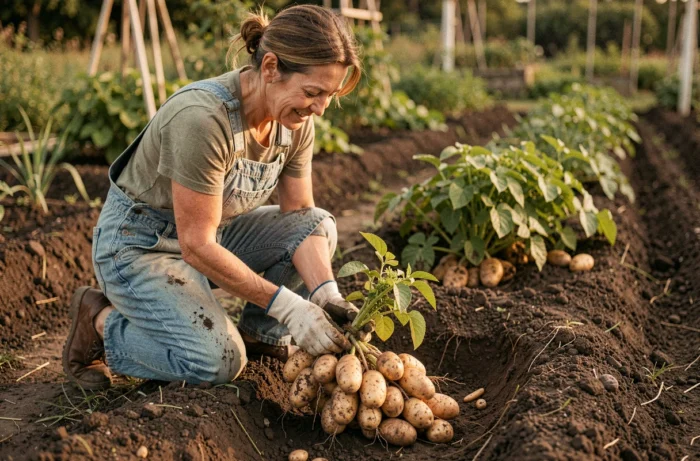
The French potato harvest of 2026 is expected to be significantly lower than in previous years, due to the combined effects of drought and repeated heatwaves. In this context, the timing of when you harvest your tubers is crucial: a few days’ delay can affect the size, storage quality, and taste of your harvest.
Thermal stress and tuber enlargement: the overlooked factor in 2026
The classic indicators of maturity (yellowing foliage, skin that no longer detaches when rubbed) remain valid in a normal year. In 2026, they are not sufficient. Industry analyses show that beyond 28 to 30 °C at soil level, tuber enlargement halts, even if the plant still appears green and active.
Specifically, foliage that yellows after a heatwave does not mean that the tubers have reached their appropriate size. It may simply indicate a sudden water stress. If your plot still has a decent water reserve, delaying the harvest by a few days after the return of milder temperatures may allow the tubers to resume their growth.
Field reports vary on this point: some producers find that early harvesting after a heatwave yields firm but small tubers. Others report an increased risk of physiological defects (hollow heart, glassiness) when waiting too long in warm soil.
There is no universal answer, which is precisely why it is important to observe your plot rather than follow a fixed calendar. To delve deeper into the maturity signals suited to this atypical season, you can discover Les Jardins de Camille, which details the harvest stages variety by variety.
Potato size in 2026: adapting the harvest to the intended use
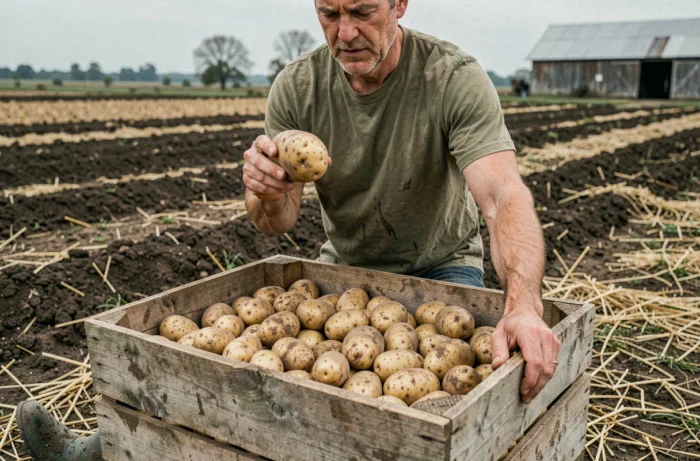
UNPT and Fédépom report a higher proportion of small and medium sizes in the 2026 production. The dry matter content varies more than in previous years, which has direct consequences on culinary use and storage.
If you are growing varieties intended for frying, the size question is central. Manufacturers have announced a temporary adjustment of their criteria, especially for sizes over 50 mm, but in the vegetable garden, the logic is the same: a tuber that is too small will yield a short and dry fry.
Two strategies based on your goal
- For quick consumption (new potatoes, salads, steaming): harvest as soon as the skin holds when rubbed, even if the size remains modest. The flesh will be tender and the flavor more pronounced.
- For storage or processing (fries, purées, winter storage): wait until the foliage has completely dried out for at least two weeks before harvesting. This delay allows the skin to thicken and the reducing sugars to decrease.
- For home plant production: harvest a little earlier than for storage, when the tubers are still of medium size. A tuber that is too large is not more productive than a reasonably sized properly pre-sprouted tuber.
Physiological defects related to climate: what to check at harvest
Arvalis warns of an increase in physiological defects in potatoes harvested in 2026. Hollow heart, glassiness, and internal cracks are directly linked to the abrupt alternations between drought and rainy episodes.
These defects are not always visible from the outside. A tuber may look perfect but reveal a hollow heart when cut. Always check a few potatoes by cutting them in half at the time of harvest.
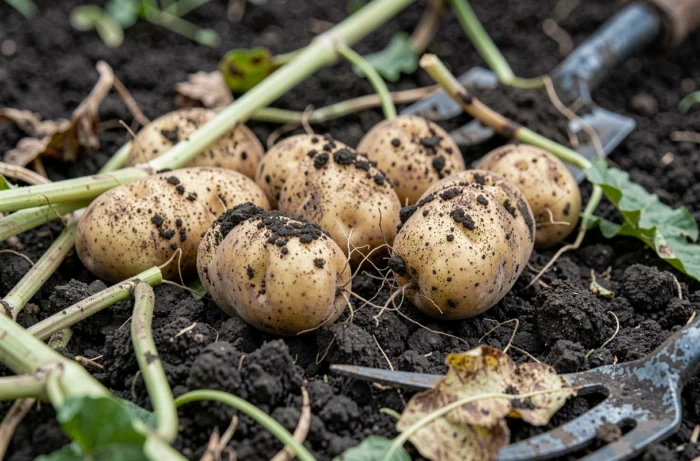
Since the dry matter is more variable this year, potatoes affected by internal defects do not store as well and are at risk of rotting in storage. Preferably direct them towards quick consumption rather than storage.
Harvest practices that limit damage
Water moderately the day before harvesting if the soil is very dry and compact. Hard soil causes mechanical shocks to the tubers, even with a fork. Slightly moist soil reduces harvest injuries and facilitates sorting.
Let the potatoes air dry for a few hours in the shade before bringing them in. However, never expose them to direct sunlight: greening begins within a few hours and makes the tubers unfit for consumption.
Soil and hilling: why preparation determines the harvest timing
Insufficient hilling exposes tubers to light and soil heat, accelerating greening and sunburn. In 2026, with surface temperatures regularly above normal, low hills have been particularly penalized.
If your hills have collapsed over the season (heavy rains, watering), some tubers may already be surfacing. In this case, do not delay: harvest as soon as the foliage starts to yellow rather than waiting for complete drying. A tuber greening in insufficient hilling loses more quality than a slightly early harvested tuber.
The quality of the soil also affects the ease of harvesting. In clay soil, excess moisture sticks the tubers to clods and makes sorting tedious. In sandy soil, prolonged drought may bury the potatoes deeper than expected. In both cases, probe a few plants by hand before starting the full harvest.
The 2026 season reminds us that the harvest date of potatoes is not written on a wall calendar. It is determined in the field, by considering the state of the foliage, soil temperature, target size, and internal integrity of the tubers. Cutting a few potatoes before harvesting everything remains the most reliable and least practiced gesture.