
Oak galls have fascinated naturalists for centuries, but they also raise legitimate questions when found in one’s garden or during a walk in the forest. These plant growths, caused by the laying of eggs by insects from the Cynipidae family, are not strictly toxic. However, the question of risk to humans deserves to be examined from several angles, particularly regarding skin reactions and misuse in self-medication.
Allergic reaction to oak pollen and confusion with galls
Before addressing the gall itself, it is important to untangle a common misconception. Many people who handle oak branches covered with galls attribute their itching or skin irritations to the growths. However, oak pollen, which is dispersed at the same time, is a recognized allergen that is sufficient to explain these symptoms.
Oaks produce abundant pollen in the spring. This pollen is a recognized allergen that causes rhinitis, conjunctivitis, and sometimes skin lesions in sensitized individuals. When shaking a branch bearing galls, pollen, plant debris, and sometimes micro-mites are also dispersed, which complicates the identification of the real cause.
An allergy diagnosis can distinguish between an oak pollen allergy and a contact reaction related to another agent. A dermatologist or an allergist can perform targeted skin tests to clarify the situation. Relying solely on self-diagnosis may delay appropriate treatment, whether it involves a local antihistamine or a systemic treatment.
To delve deeper into the interactions between oak galls in humans and possible skin reactions, it is useful to cross-reference botanical information with medical advice.

Direct contact with galls: skin irritation and microorganisms
The oak gall, as a plant structure, does not contain any stinging substance comparable to that of nettles or sumac. Its surface can be smooth, spongy, or rough depending on the species of cynipid responsible. Handling a fresh gall with bare hands generally does not provoke any reaction in a person without a specific allergic background.
The risk arises in two specific scenarios:
- The gall is open or decomposing, which encourages colonization by molds and secondary mites capable of causing itching and scratch lesions in sensitive individuals.
- The person has a pre-existing contact eczema. The tannins concentrated in certain galls (notably the nut galls of the type Andricus kollari) can exacerbate dermatitis on already weakened skin.
- Micro-cuts on the hands during handling allow the entry of bacteria present on the surface of the gall, with a risk of local infection if the wound is not cleaned.
In all these cases, the treatment remains simple: washing with soap and water, applying a local antiseptic, and consulting a doctor if symptoms persist beyond a few days.
Self-medication with oak galls: a risky use on mucous membranes
A rarely discussed angle by gardening sites concerns the diversion of oak galls as a “natural remedy.” Some traditional preparations use gall powder for applications on the skin or mucous membranes, particularly in gynecology. None of these uses have undergone rigorous scientific validation.
Galls are rich in astringent tannins. When applied to a mucous membrane, these tannins cause local drying, which can give a temporary sensation of “tightening” of the tissues. This sensation is purely mechanical and does not constitute a therapeutic effect.
Documented risks of application on mucous membranes
Applying gall powder or decoction to the genital mucous membranes exposes individuals to several complications. Excessive drying alters the protective microbial flora and promotes infections. Repeated irritations on weakened mucous membranes increase the risk of bacterial or fungal superinfection.
Current medical recommendations emphasize that treatments applied to mucous membranes should be evidence-based and prescribed by a professional. Unassessed herbal preparations, including oak galls, fall into the category of discouraged practices.
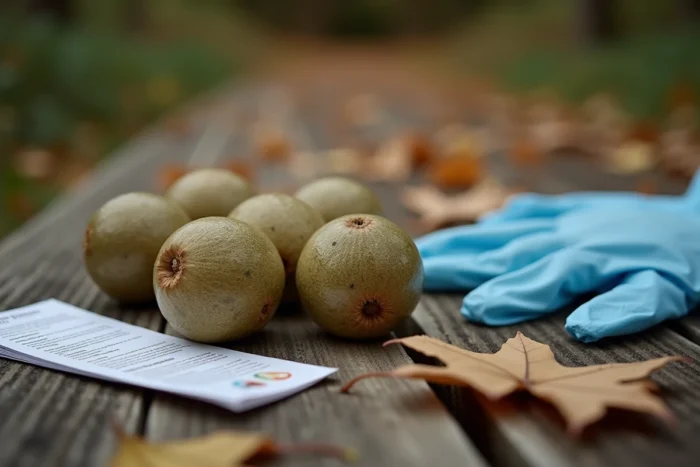
Practical precautions in the garden and forest
For gardeners and walkers, oak galls do not pose a direct health hazard. The tree is not significantly weakened by a few galls, and the growth does not “contaminate” the soil or neighboring plants.
Some common-sense precautions are sufficient:
- Wear gloves when pruning branches covered with decomposing galls, especially if you have cuts on your hands or a history of eczema.
- Avoid touching your face after handling, until you can wash your hands, to limit contact with mold spores or tannin residues.
- Do not use crushed galls as soil amendment without prior composting, as concentrated tannins can inhibit the germination of certain seeds.
- Consult a doctor (dermatologist or allergist) if recurrent itching occurs after each contact with oak, in order to establish a precise diagnosis between pollen allergy and contact reaction.
Children and oak galls
Children are eager to collect these “balls” from oak leaves. The act itself does not pose any particular risk, provided they do not put the gall in their mouths. Accidental ingestion of gall fragments may cause nausea due to the bitterness of the tannins, without known serious toxicity.
Washing hands after handling remains the most effective precaution, as with any object collected in a natural environment.
Oak galls remain primarily a remarkable biological phenomenon, much more concerning for the entomologist studying the cynipid life cycle than for the walker who encounters them. The real risk does not come from the gall itself, but from the unregulated uses that can be made of it, particularly on mucous membranes. In case of doubt about a skin reaction after contact with an oak, a doctor can provide a reliable diagnosis and guide towards appropriate treatment.