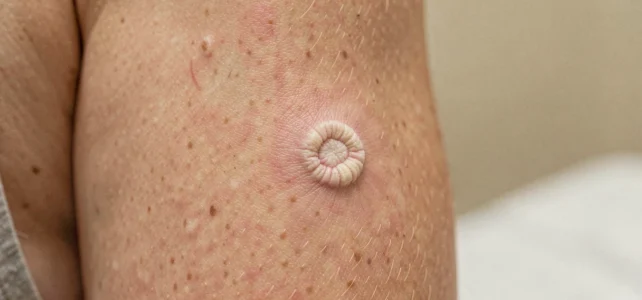
Most people vaccinated with the BCG have a small round mark on their arm, slightly recessed or raised, that never fades. This BCG vaccination scar is intriguing because no other vaccine in the French vaccination schedule leaves a comparable trace. The reason lies less in the needle than in what happens under the skin in the weeks following the injection.
Tuberculoid granuloma: the immune reaction that sculpts the skin
The BCG is a live attenuated vaccine derived from the Calmette and Guérin bacillus. Unlike inactivated vaccines or mRNA vaccines, it contains live bacteria (a weakened strain of Mycobacterium bovis) injected intradermally. This specificity triggers a local inflammatory cascade that is much more intense than a simple reaction at the injection site.
In the days following vaccination, a papule appears. It evolves into a small ulceration, sometimes topped with a crust, which takes several weeks to heal. Beneath the surface, the immune system establishes an intradermal tuberculoid granuloma: an organized cluster of macrophages, lymphocytes, and epithelioid cells that encircle the vaccine bacteria to contain them.
This granuloma is not an undesirable side effect. It is proof that the immune system has recognized the pathogen and built a defense. The resulting chronic inflammatory reaction permanently remodels the deeper layers of the dermis, replacing normal tissue with fibrous scar tissue. The BCG vaccination scar on the arm is therefore the visible trace of an organized inflammation that lasted several weeks, not just that of a simple injection.

Why other vaccines do not leave a scar
A vaccine against influenza, tetanus, or hepatitis B is injected into the muscle (intramuscular route) or under the skin (subcutaneous route). The inflammatory reaction remains brief and deep, without visible remodeling of the dermis on the surface.
The BCG, on the other hand, is strictly injected into the dermis, the superficial layer of the skin. It is this location that makes the reaction visible. Combined with the live nature of the vaccine and the duration of the granulomatous inflammation, the intradermal injection ensures that the scar forms at a level accessible to the eye.
Another historical vaccine also left a mark: the smallpox vaccine, administered by scarification (superficial incisions in the skin). Its scar, often larger and more irregular than that of the BCG, reflected a different mechanism. Where the BCG causes a granuloma, the smallpox vaccine created a vesicular lesion through local viral multiplication in the epidermis. The two scars are easily distinguished:
- The BCG scar is generally round, small in diameter, slightly depressed or raised, with a clear outline.
- The smallpox vaccine scar is larger, sometimes irregular, with a rougher surface appearance due to multiple scarifications.
- The BCG was performed on the upper arm (deltoid), while smallpox vaccination could be done in the same place or on the forearm depending on the era and country.
Phototype, keloids, and individual variations of the BCG scar
Not all BCG scars look alike. Some people have a barely noticeable mark, while others have a thick and prominent scar. This variability is due to several factors that popular articles rarely address.
Skin phototype plays a role. On light skin, the scar tends to remain discreet and slightly paler than the surrounding skin. On dark skin or skin prone to keloids, the scar may evolve into a hypertrophic formation, thicker and more visible, sometimes slightly raised for years.
The injection technique also matters. An intradermal injection that is too deep or too superficial alters the size and appearance of the scar. The age at the time of vaccination also influences the result: an infant, whose skin is thin and immune system is maturing, often develops a more discreet scar than a child vaccinated at an older age.
Some vaccinated individuals show no visible scar. This does not mean that the vaccine did not work. The absence of a BCG scar does not indicate a lack of protection. The immune response may have developed normally without leaving a perceptible skin trace, depending on the depth of the granulomatous reaction and the individual’s healing capacity.

BCG vaccination in France: a changed context
BCG vaccination was mandatory in France for all children until 2007. Since that date, it is no longer systematic but remains recommended for children at high risk of tuberculosis, particularly those born into families from high-prevalence areas or living in certain regions of France.
This evolution explains why the majority of French adults born before 2007 bear this scar, while subsequent generations do not systematically have it. The BCG remains the only available anti-tuberculosis vaccine. Its effectiveness is well documented against severe forms of tuberculosis in children (tuberculous meningitis, miliary tuberculosis), even though its protection against pulmonary tuberculosis in adults is subject to more nuanced data.
The tuberculin test (intradermal reaction to tuberculin) allows verification if a person has been exposed to the bacillus or responded to the vaccine. A previous BCG can make this test positive, which sometimes complicates diagnostic interpretation in vaccinated individuals.
A scar that tells a vaccination strategy
The round mark on the arm is a vestige of a time when tuberculosis represented a major public health threat in France. The persistence of this scar is due to a precise mechanism: a live vaccine, injected into the dermis, causes a chronic granulomatous inflammation that permanently remodels the skin tissue.
The variations in appearance between individuals depend on phototype, injection technique, and personal healing capacity, not on the vaccine’s effectiveness. With the lifting of the vaccination requirement in 2007, this scar is gradually becoming as much a generational marker as a medical one.